
Full Productivity and Full Flexibility: two approaches, one philosophy
From maximum productivity to maximum flexibility, System Ceramics develops solutions tailored to different manufacturing models without compromising performance, reliability or automation.
In the ceramic industry, there is no such thing as a single ideal production line. Manufacturers operate according to different production models, each with specific requirements in terms of output, product mix, available space and plant organisation. For this reason, the first step in designing technology is to understand the customer’s objectives. The real question is not which solution is the most advanced, but which one is best suited to achieving those objectives.
With this in mind, System Ceramics pursues a philosophy based on the concepts of Full Productivity and Full Flexibility, two distinct approaches that stand at the opposite ends of a spectrum spanning a wide range of tailor-made solutions.
Both are guided by the same philosophy: using automation to achieve the highest levels of performance and competitiveness in line with manufacturers’ actual production needs.
Full Productivity: productivity as a competitive advantage
The Full Productivity approach is suitable for high-capacity plants with kiln outputs exceeding 20,000 m² per day, typically characterised by asynchronous production cycles: 24 hours up to the kiln but only 12-16 hours through the subsequent sorting and packaging stages.
In these environments, every stoppage, manual intervention or inefficient process has a measurable impact on overall productivity. The efficiency of a production line is therefore determined not simply by the speed of individual machines, but above all by the ability of the entire system to operate continuously, automatically and without interruption.
The architecture developed by System Ceramics redefines the traditional production sequence: tiles are first stored and then automatically retrieved and sorted. This design approach requires a high degree of integration between software and automation while significantly improving the overall efficiency of the production line.
The configuration is conceived as an integrated ecosystem in which every technology performs a specific function: eliminating bottlenecks, reducing manual intervention and maintaining a continuous production flow.
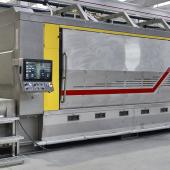
At the kiln exit, Check Point immediately detects structural defects, avoiding unnecessary use of storage capacity.
From there, Multistorage provides virtually unlimited storage capacity, adapting to both the available space and the production flow rate, while Multibuffer ensures continuity even during slowdowns or product changeovers.
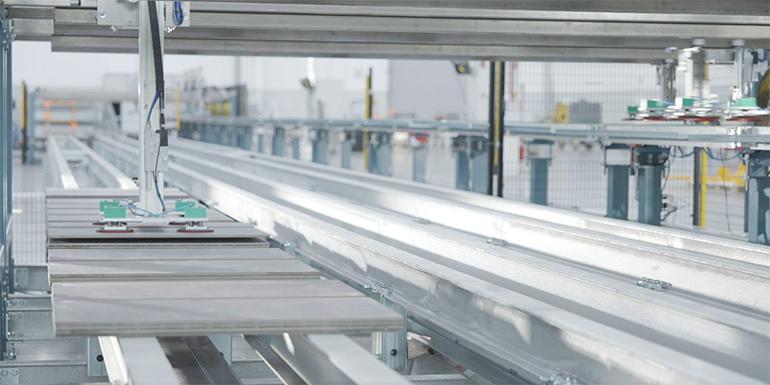
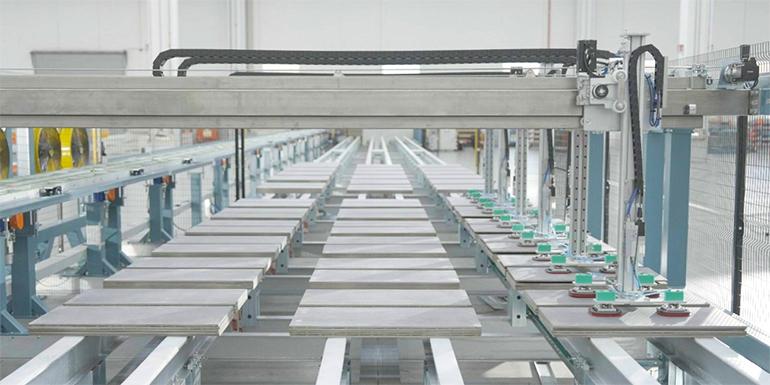
Quality inspection is handled by Qualitron, a vision control system capable of analysing up to 200 tiles per minute to accurately detect shade variations, graphic defects and structural imperfections. Multigecko then automatically sorts up to 14 product selections through software-controlled changeovers without interrupting production.
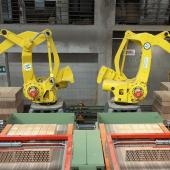
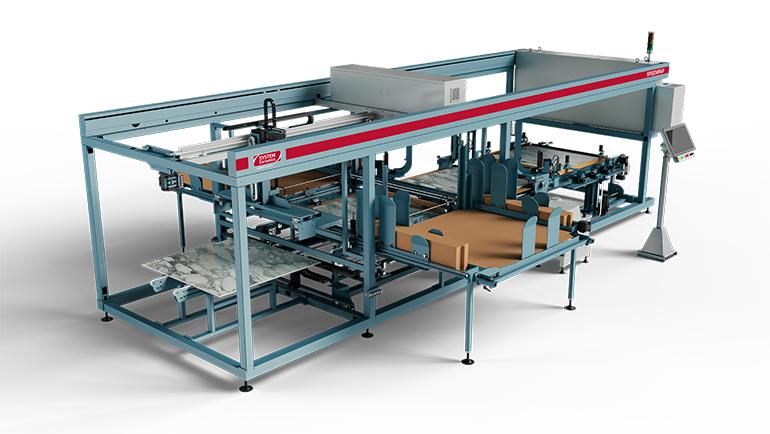
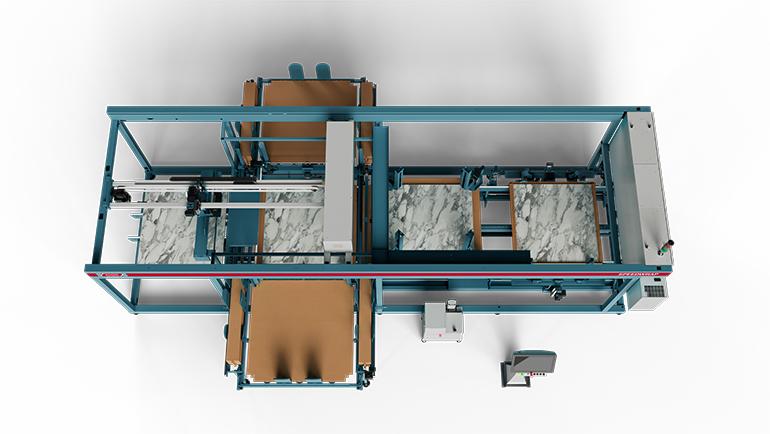
In the final stages of the line, Speedwrap delivers high-productivity packaging with dynamic changeovers and wrap-around or tray solutions, while Eagle completes the process with intelligent palletising capable of handling multiple product streams simultaneously.
This is not simply a sequence of machines, but an integrated system designed to maintain a constant production pace while maximising automation, continuity and efficiency.
Full Flexibility: the value of flexibility
Competitiveness, however, is not determined by production volume alone. More and more manufacturers need to manage complex product portfolios, small batches, multiple formats, large slabs and rapidly changing market demands. In these environments, success hinges less on turning out the same product as quickly as possible and more on reconfiguring production rapidly without compromising efficiency or quality.
This is where Full Flexibility comes into play.
While Full Productivity is built around production continuity, Full Flexibility focuses on adaptability. The entire architecture is designed to manage multi-product production, non-linear layouts and frequent changeovers without compromising efficiency or quality. Here, automation serves a different purpose: rather than focusing exclusively on productivity, it manages variability, turning process complexity into a competitive advantage.
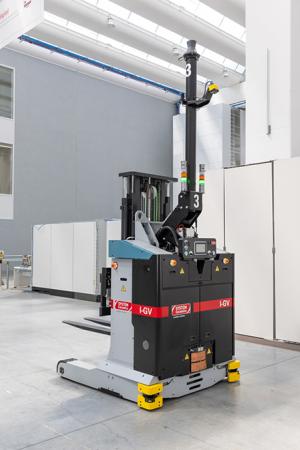
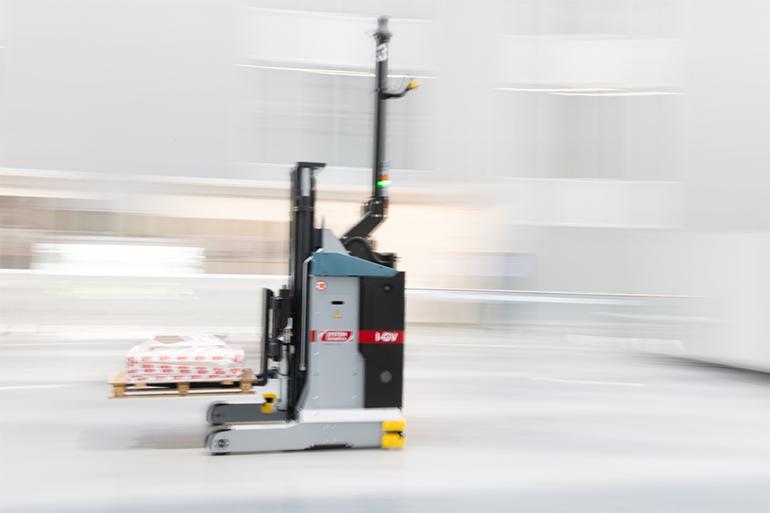
As with Full Productivity, the various technologies operate as a single integrated system. Fastroll combines storage, loading, unloading and buffering in one compact solution, while I-GVs, the autonomous guided vehicles developed by System Ceramics, move materials throughout the production process, optimising routes and adapting to even the most complex plant layouts. In the CW Big Size version, they also enable the safe and precise handling of large slabs.
At the kiln exit, Multistore automatically handles both slabs and traditional tile formats, while Rotostore provides high-speed loading for conventional sizes.
Qualitron continues to perform quality inspection, while Multigecko automatically sorts production runs characterised by frequent product changeovers and multiple product selections.
In the final stage of the line, Multiflex delivers fully customised just-in-time packaging with integrated printing, while the Falcon Slab and Griffon palletising systems handle large slabs and traditional tile formats respectively.
Flexibility therefore becomes a driver of efficiency.
True innovation lies in customisation
Although industrial innovation is often associated with increasingly complex technologies, complexity and value do not necessarily go hand in hand.
A production system designed around actual manufacturing needs delivers greater efficiency than an oversized solution and ensures that investment is directed where it generates measurable returns.
This is the philosophy behind every System Ceramics solution. Full Productivity and Full Flexibility represent the two ends of a design spectrum within which tailor-made configurations can be created while maintaining the same technological excellence, reliability and level of support across every System Ceramics installation. Supported by customer service and technical assistance throughout the entire lifecycle of the plant, every configuration continues to evolve over time, keeping pace with the manufacturer’s growth and future production requirements.
Ultimately, the best technology is not the most complex one; it is the one that enables every manufacturer to unlock the full potential of their specific business model.

Did you find this article useful?
Join the CWW community to receive the most important news from the global ceramic industry every two weeks





Related articles



Read more