

Eco-sustainable innovation in response to new emission limits
Facing increasingly stringent regulations on industrial emissions, Poppi Clementino has introduced an innovative dual-use flue gas treatment plant designed to abate acidic pollutants with maximum flexibility and efficiency.
European and Italian regulations on industrial emissions are becoming increasingly stringent, particularly for chlorinated and fluorinated compounds. For companies that adopt thermal processes, adapting to these lower emission limits is no longer optional but an urgent necessity for the purposes of both environmental sustainability and regulatory compliance.
Dual-use plant: a flexible solution
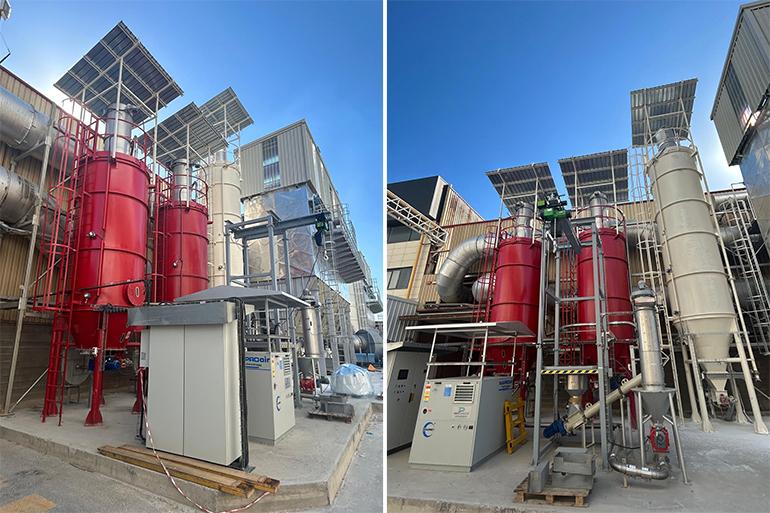
Against this backdrop, Poppi Clementino has introduced an innovative dual-use flue gas treatment plant designed to abate acidic pollutants with maximum flexibility and efficiency. Depending on process requirements and emission peaks, it can use two different reagents:
- Sodium bicarbonate (NaHCO₃), which is ideal for the efficient abatement of acidic pollutants (such as hydrochloric acid HCl, hydrofluoric acid HF and sulphur oxide-based compounds SOx) under a wide range of operating conditions;
- Hydrated lime Ca(OH)₂, a traditional yet still effective reagent that represents a viable alternative and is particularly suited to the abatement of sulphur oxides and acidic pollutants.
This versatility is crucial for ensuring consistently high purification performance while optimising operating costs and reagent management.
Intelligent dosing and management technology
The key features of the system are its intelligent automation and reagent logistics. Dual-purpose silos were installed to offer two refilling options:
- directly from tankers in the case of hydrated lime, a solution designed to optimise logistics when handling large volumes;
- via a big-bag emptying system with pneumatic conveying for fine-grained sodium bicarbonate, a solution that allows for flexible management or for use in the event of need.
The highly sophisticated dosing system controls the flow rate of the selected reagent (sodium bicarbonate or hydrated lime) in real time according to instantaneous flue gas readings. This dynamic calibration ensures that only the quantity of reagent strictly necessary to keep emissions below the legal limits is used. This guarantees:
- continuous compliance with the new regulatory limits;
- cost effectiveness thanks to reduced reagent waste;
- lower environmental impact due to optimised generation of residues.
Recovery and management of inert product
Another key feature of the system is the management of spent reagent residues recovered from the filter’s dust discharge, where the plant again offers a flexible, closed-loop approach.
If the chemical characteristics of the inert product (such as neutrality) allow it to be reused safely in the production process, it can be transported pneumatically to dedicated silos and reintroduced into specific cycles.
Alternatively, the residues can be conveyed to silos for controlled, safe and compliant disposal.
High performance and remote assistance
The entire automation system is designed to ensure high levels of operational performance and reliability. For this purpose, Poppi Clementino has integrated advanced remote-assistance tools that enable its service team to monitor the plant and intervene promptly when needed, ensuring continuous operation with minimal downtime.
This kind of dual-use plant represents a clear example of how innovative plant engineering can provide a concrete, sustainable response to the growing environmental and regulatory challenges faced by industrial sectors.

Did you find this article useful?
Join the CWW community to receive the most important news from the global ceramic industry every two weeks





Related articles






Read more