
I.Cer.S conference on ceramic raw materials proves a big success
More than 200 participants attended the conference held on 5 February in Sassuolo. The event also featured the launch of the new Ceramic Raw Materials Manual 2026.
More than 200 professionals, including both in-person and online participants, attended the conference entitled “Raw Materials for Ceramic Tiles” held on 5 February at the Confindustria Ceramica auditorium in Sassuolo. Organised by the Italian Ceramic Society, this much-anticipated annual industry event once again provided high-level technical content and in-depth sector insights.
Introduced and moderated by ICerS Chair Cristina Siligardi, the conference featured a prestigious line-up of speakers. These included Michele Dondi (ISSMC-CNR), who presented the new Atlas of Raw Materials for the Glass and Ceramic Industries, and Armando Cafiero, Director General of Confindustria Ceramica, who opened the proceedings by detailing the types, volumes and origins of the raw materials used by the Italian ceramic industry in 2025.
Last year, Cafiero explained, the Italian ceramic tile industry produced approximately 380 million square metres of tiles, consuming 8 million tonnes of raw materials for the ceramic body. Half of these volumes – approximately 3.9 million tonnes – transited through the port of Ravenna. This consisted of 2.1 million tonnes of Turkish feldspar and approximately 1.8 million tonnes of clay, imported mainly from Turkey (27%), India (24%), Ukraine (23%) and other countries (26%). Added to this, approximately 50,000 tonnes of kaolin arrived from Turkey (28%), France (22%), Brazil (19%), Ukraine (15%) and other countries (16%). A further one million tonnes of clay reached the Sassuolo production hub by rail from Germany. Cafiero reiterated that sourcing alternative raw materials remains a strategic priority for Confindustria Ceramica, especially given the sector’s high dependence on Turkish feldspar.
What are the alternatives?
Representatives from several companies discussed the feasibility of using alternative or secondary raw materials. Among these, Europomice described the technological performance of Italian volcanic raw materials in porcelain stoneware bodies. Focusing on the circular economy, Mineraria di Boca presented a study on the reuse of ceramic by-products and waste, while Sibelco illustrated the potential for integrating recycled glass into body formulations. Finally, reports from Effediesse and Minerali Industriali discussed alternative, non-traditional supply sources.
The new Ceramic Raw Materials Manual 2026
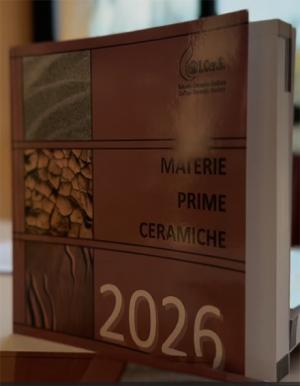
A highlight of this year’s conference was the presentation of the new Ceramic Raw Materials Manual 2026, published by the Italian Ceramic Society ten years after the previous edition. This update was essential given the radical transformation of supply chains following the disruption of supplies from Ukraine in 2022. Fittingly, an entire chapter written by Stefano di Primio (Minerali Industriali), analysed the production, logistical and economic repercussions of the forced replacement of Ukrainian clays, with a focus on the technological impact on body formulations.
The largest section of the book, written by Michele Dondi, provides detailed mapping of raw material deposits for tiles in 38 European countries, alongside a census of the primary clay basins in Africa, the Middle East, Asia and the Americas.
The first part of the manual, co-authored by Claudia Carbonchi (Eurit) and Stefano di Primio, describes the technical and mineralogical characteristics of all the raw materials (for both bodies and glazes) used in tile production. The aim is to provide ceramic technologists with a practical reference tool to help them understand the behaviour of different raw materials and avoid issues during production.
Videos (only Italian language)
- Cristina Siligardi comments on the success of the event
- Hear from the authors of the manual:
Michele Dondi, Stefano di Primio and Claudia Carbonchi

Did you find this article useful?
Join the CWW community to receive the most important news from the global ceramic industry every two weeks





Recent articles

Ceramic World Review 167/2026

Powtech Technopharm 2026

Main topics
Read more